The Mystery of the FUTHARK Alphabet

The Möjbro stone from Uppland, which is a memorial monument:
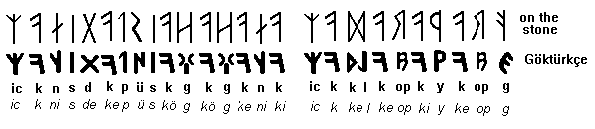
In this script, our attention is drawn to the placement of some characters backwards. Especially, the rune R, read as “op”, is peculiar. For this reason, I have read it as “po”. Reading from right to left, starting with the bottom line:
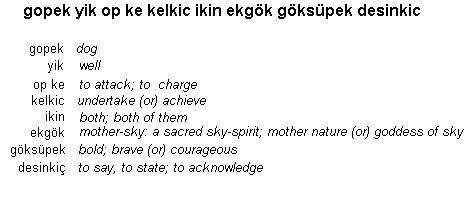
The meaning obtained thru reading the above piece, as if it were written in ancient Turkish, can roughly be rendered in today’s English as follows: (May both of) the dog(s) charge well; so that the sacred sky-spirit acknowledges their boldness..
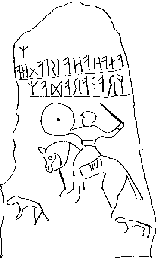
On this stone, under the inscription, there is a carving of a rider on his horse, holding up a round shield in his left hand while brandishing his weapon in his right. There are two dogs running beside the horse, as if all of them are engaged in an attack.

Also, the writing style of the symbols and the density of symbols, means the less character spacing, on the left corner, proves the original writing style was from right to left.

, by Kartavirya This entry was posted in Metahistory, Sacred Art. Bookmark the permalink. Post a comment or leave a trackback.

Post a Comment

Your email is never published nor shared. Required fields are marked *

You may use these HTML tags and attributes <a href="" title=""> <abbr title=""> <acronym title=""> <b> <blockquote cite=""> <cite> <code> <del datetime=""> <em> <i> <q cite=""> <s> <strike> <strong>

*
*

  • Within a nominally Christian world, chivalry upheld without any substantial alterations an Aryan ethics in the following things: (1) upholding the ideal of the hero rather than of the saint, and of the conqueror rather than of the martyr; (2) regarding faithfulness and honor, rather than caritas and humbleness, as the highest virtues; (3) regarding cowardice and dishonor, rather than sin, as the worst possible evil; (4) ignoring or hardly putting into practice the evangelical precepts of not opposing evil and not retaliating against offenses, but rather, methodically punishing unfairness and evil; (5) excluding from its ranks those who followed the Christian precept ‘Thou Shalt Not Kill’ to the letter; and (6) refusing to love one’s enemy and instead fighting him and being magnanimous only after defeating him.

    - Julius Evola, Revolt Against the Modern World, p. 298-99.